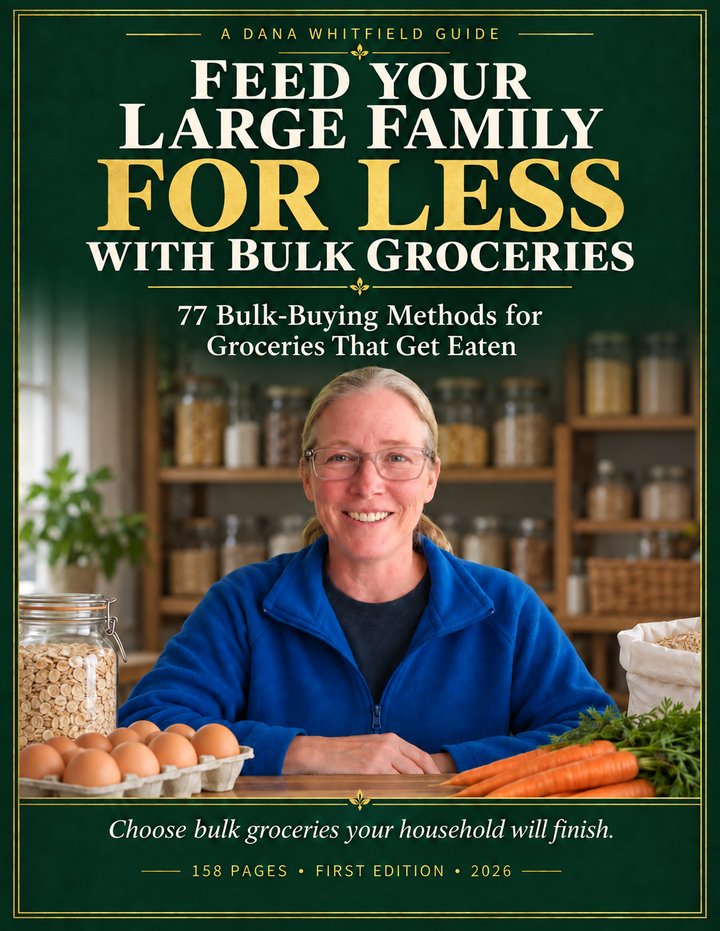
Feed Your Large Family for Less With Bulk Groceries
You may be bringing home cases that look practical at checkout but sit behind food you already have. This book gives you 77 methods for choosing, storing, rotating, and using bulk groceries your household is positioned to finish.
Plus 3 separate bonus books.Including Freezer Zone Labels.
One digital bundle. PDF to read or print, plus EPUB for e-readers.
158Pagesin the main book
11Chaptersread in any order
77Methodspick what fits
3Bonus booksall included
Instant downloadPDF + EPUB for any device or e-reader
14daysRead-It-First Guarantee14 days, every dollar back
01 · How it helps
For the moments when the cart looks right but the shelves say otherwise
Bulk buying has a volume problem before it has a price problem. These methods help you look at what your household uses, where it will go, and what it replaces.
1Before the warehouse run
Only some of us eat this. How much should I buy?
✓Item-Specific Eater Count: give each food its own roster of the people who actually eat it, instead of using your full headcount. Chapter 01
How do I keep a big sale sign from changing my mind?
✓Walk-Away Unit Price Written Before the Trip: use a receipt to write your top unit price, then refuse to raise it in the aisle. Chapter 05
2In the aisle
Should I buy a case of a food we have never tried?
✓Sample-Size-First Rule for New Foods: buy the smallest ordinary package first and keep the case at no-buy until the trial ends. Chapter 05
Is the bigger can cheaper after I pour off the liquid?
✓The Drained-Weight Check: if you pour away the packing liquid, price only the food you keep, using the printed drained weight. Chapter 07
3When storage is tight
Will this case really fit on the shelf I am picturing?
✓Case Dimensions vs. Empty-Space Template: make a full-size cardboard outline of the case and compare it with space that is empty now. Chapter 11
Can I buy the bread multipack and make freezer room later?
✓Bakery Multipack Freezer-Space-or-Skip Test: measure the freezer space you can use now. If it needs rearranging later, skip the multipack. Chapter 03
4When food lingers
Why does the same snack flavor always get left behind?
✓Snack Variety-Pack Rejected-Flavor Count: tally what is left by flavor. If the same unwanted flavor keeps remaining, stop buying that exact assortment. Chapter 03
Why do we always have several open bags of the same thing?
✓Open-Pack Control: mark the active pack with a marker or clip, and finish it before opening another, unless a meal needs more. Chapter 06
02 · What’s inside
11 chapters, 77 stand-alone methods
Each chapter takes one part of household volume control and breaks it into methods you can use on their own. You can start with the problem in front of you, then use the tomorrow prompt to take a small next step.
01
What Your Family Actually Finishes
7 methods
The 14-Day Household Consumption Log
Label Servings vs. Household Portions Check
Fast-, Medium-, and Slow-Mover Grocery Sort
Opened-Package Finish-Time Check
Household Eater Count by Item
School-Week vs. Weekend Use-Rate Split
Seasonal Appetite Adjustment for Case Quantities
02
The Case-Quantity Break-Even
7 methods
Case Quantity to Family-Days Conversion
Planned Servings vs. Package Servings Gap
Required Open-at-Once Quantity Check
Minimum Uses Needed to Beat the Smaller Pack
Maximum Waste Before the Deal Disappears
Repacking Labor and Supplies Cost
One-Missed-Week Demand Stress Test
03
Stop-Buying Checks for High-Waste Foods
7 methods
Bulk Produce Planned-Use Window
Bakery Multipack Freezer-Space-or-Skip Test
Bulk Dairy Finish-Date Plan
Snack Variety-Pack Rejected-Flavor Count
Giant Condiment Uses-per-Week Check
Frozen Convenience-Food Repeat-Meal Test
Specialty Ingredient Three-Recipe Requirement
04
The True Cost of the Warehouse Cart
7 methods
Membership Fee Allocated to Grocery Savings
Fuel and Travel Time Added to the Warehouse Run
Delivery, Pickup, and Service Fee Comparison
Unplanned Basket Add-On Total
Storage Bags, Containers, and Labels Cost
Expected Spoilage Added Back to Unit Cost
Credit-Card Interest Added to Stock-Up Savings
05
Before the Case Goes in the Cart
7 methods
Seven-Question Bulk-Buy Gate
Sample-Size-First Rule for New Foods
Three-Specific-Uses Before Purchase
Empty-Shelf-or-Freezer-Slot Requirement
Walk-Away Unit Price Written Before the Trip
Weekly Stock-Up Cash Cap
One-In, One-Out Limit for Slow-Moving Cases
06
Use It Before It Becomes Waste
7 methods
Case-to-Meal Assignment Sheet
First-Seven-Days Use Schedule for New Cases
One Inner Pack Open at a Time
Use-First Bin for Partial Cases
Variety-Pack Flavor Allocation by Family Member
Half-Case Consumption Review
Last-Quarter Use-Up Trigger
07
The Usable Unit Price
7 methods
Price per Ounce When Package Units Differ
Price per Count for Bars, Pouches, and Cups
Price per Household Serving Instead of Label Serving
Drained-Weight Cost for Canned Foods
Concentrate-to-Prepared-Yield Price Comparison
Bone-In vs. Boneless Edible-Portion Cost
Warehouse Regular Price vs. Supermarket Sale Price
08
The Cheaper Size, Brand, or Store
7 methods
Warehouse Case vs. Supermarket Family Pack
Store Brand vs. National Brand Cost-and-Acceptance Trial
Club Two-Pack vs. Two Single Packs on Sale
Bulk-Bin Staple vs. Prepacked Bag
Subscription Delivery vs. Local Shelf Price
Frozen vs. Fresh Usable-Serving Cost
Whole Item vs. Preportioned Pack Cost
09
Busy-Week Meal Stock
7 methods
Household’s Ten Dependable Staples List
Five-Dinner Complete-Meal Coverage Check
Protein-and-Two-Sides Pairing Matrix
Breakfast Backup by Family Serving Count
Packable Lunch Reserve by School Day
Busy-Night Meal Kit Built from Existing Stock
Takeout-Trigger Replacement Meal List
10
Movement Rates and Reorder Points
7 methods
Seven-Day Fast-Mover Count
Days-of-Supply Label for Each Staple
Minimum-On-Hand Reorder Line
School-Week and Holiday Reorder Split
One-Case Maximum for Slow Movers
Withdrawal Tally on Open Cases
Duplicate-Purchase Check Before Every Run
11
Pantry, Refrigerator, and Freezer Capacity
7 methods
Pantry Shelf-Footprint Map
Freezer Empty-Space Meal-Count Map
Refrigerator Empty-Space Count for Multipacks
Case Dimensions vs. Empty-Space Template
Repacking Time Estimate Before Checkout
Freezer Space Cost per Planned Meal
Overflow Decision: Share Sealed Packs, Delay, or Skip
03 · Your 3 bonus books
Three practical bonus tools
The bonus PDF files give you places to put the methods to work. They cover freezer zones, case-size comparisons, and the reset after a large grocery trip.
$28 estimated bonus valueAll 3 included with your $27 book
Bonus book 1 of 3
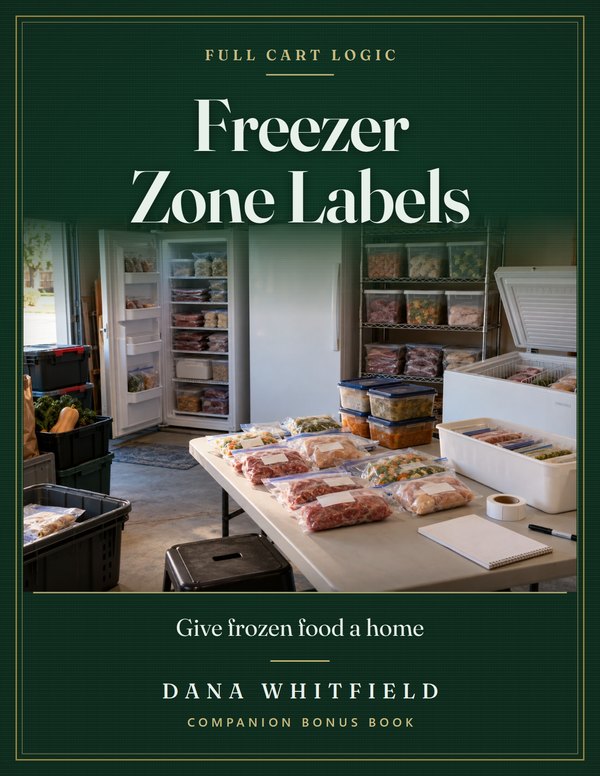
Freezer Zone Labels
Give frozen food a home.
Give every frozen portion a clear home, date, and next-use cue so the family can find what is available before another package goes into the cart. 7 pages.
Estimated value $9Included with the $27 book
Bonus book 2 of 3
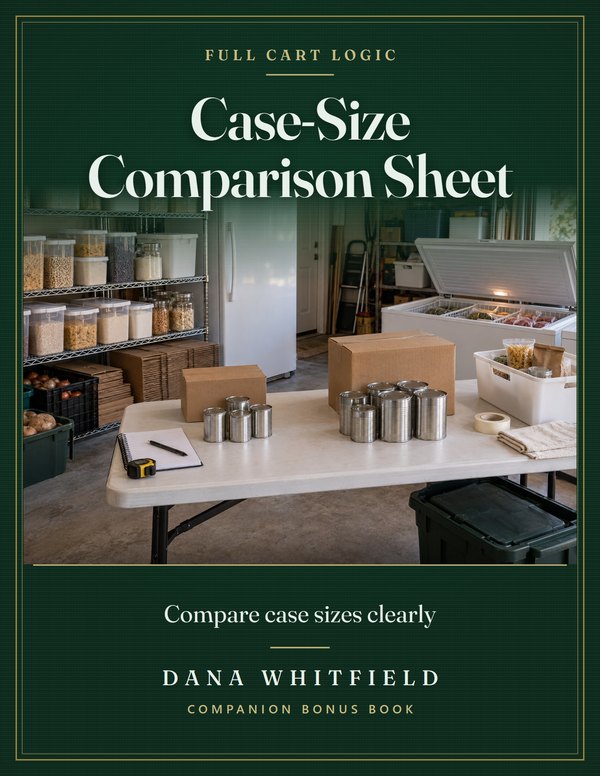
Case-Size Comparison Sheet
Compare case sizes clearly.
Put two package sizes on the same basis and see whether the apparent bargain still wins after expected use, storage limits, and avoidable waste are counted. 7 pages.
Estimated value $12Included with the $27 book
Bonus book 3 of 3
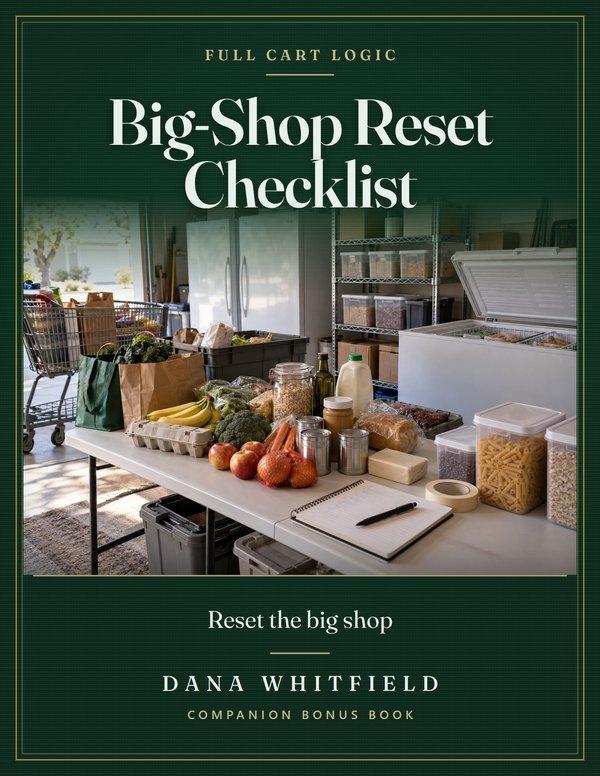
Big-Shop Reset Checklist
Reset the big shop.
Convert a full cart into a working household plan by assigning storage, naming the first foods to use, and recording what should not be bought again yet. 7 pages.
Estimated value $7Included with the $27 book
Plus, at no extra charge: lifetime updates to the main book.
Individual values are estimates set by Dana Whitfield, not previous selling prices. No physical books are shipped.
04 · The honest part
What you won’t find in this book.
✕Not in this book: A universal bulk list for every family.
I show you how to look at your own household's movement, storage, and eating patterns.
✕Not in this book: A claim that the lowest shelf price is always the best choice.
I show you how to compare what a package costs against what your household can use.
✕Not in this book: A reason to fill every open shelf or freezer space.
I show you how to treat available space as part of the purchase decision.
✕Not in this book: Professional-only work presented as a household method.
I point out when the relevant method says who to call instead.
Dana
Dana Whitfield
05 · Who wrote it
Warehouse logic for a real household
Dana Whitfield lives outside Columbus, Ohio, and shops for a household where a single grocery run can mean several carts, stacked cases and a freezer that has to earn every inch.
For 16 years she has bought pallet-scale food inventory for a regional grocery warehouse: comparing case sizes, tracking what moves, spotting duplicate ordering, and seeing how packaging changes the real amount a household brings home.
Her book works with the limits every household has: freezer shelves, pantry space, changing appetites, school weeks, and the food already waiting behind the new purchase.
PDF and EPUB editions to download, read or print. No subscription. No shipping.
158 pages · 11 chapters · 3 bonus books
Feed Your Large Family for Less With Bulk Groceries
For $27, you receive the 158-page digital book, a 58-page workbook, and three bonus PDF files. Your files are available as an instant download after payment, with no subscription and no shipping.
$27$37Launch price — ends October 08
The material helps you make your next grocery decision from what is already in the house.
What you get for $27:
Individual values below are publisher estimates. Everything is included in your $27 purchase.
Feed Your Large Family for Less With Bulk Groceries
77 Bulk-Buying Methods for Groceries That Get Eaten
$37
Bonus book 1Freezer Zone Labels
Give every frozen portion a clear home, date, and next-use cue so the family can find what is available before another package goes into the cart. 7 pages.
Est. value$9Included
Bonus book 2Case-Size Comparison Sheet
Put two package sizes on the same basis and see whether the apparent bargain still wins after expected use, storage limits, and avoidable waste are counted. 7 pages.
Est. value$12Included
Bonus book 3Big-Shop Reset Checklist
Convert a full cart into a working household plan by assigning storage, naming the first foods to use, and recording what should not be bought again yet. 7 pages.
Est. value$7Included
The printable field kit
58 printable pages: the worksheets and cards to use beside the book.
Included
Lifetime updates
Future revisions of this book at no extra charge.
$21
3 bonus books combined$28
Total estimated package value$86
You pay today$86$27
Secure one-time checkout. Your digital books are ready to download after confirmed payment.
Instant download · PDF + EPUB · print only the pages you need
Published by Dana Whitfield
14days
The Read-It-First Guarantee. Read the whole book and try it for 14 days. If it is not worth what you paid, ask for your money back through Whop, where you paid, and every dollar comes back, no questions asked. Whatever you have already downloaded, bonus books included, stays yours. You should not have to judge a book by its sales page.
07 · Questions
Questions worth answering
What exactly do I receive?
You receive the 158-page digital book, a 58-page workbook, and three bonus PDF files. They are delivered as an instant download after payment.
Can I print it?
The book, workbook, and bonus materials are PDF files. You can use the files in the format that works for your household.
Is it for me?
This book is for a reader who wants independent methods for large-family volume control. It is built around household constraints such as pantry space, freezer space, changing appetites, school weeks, and food already on hand.
How do I start?
Start with the chapter that matches the grocery problem in front of you. Each chapter includes a tomorrow prompt for a practical next action.
What if it does not help me?
Ask for your money back through Whop within 14 days and every dollar comes back, no questions asked. That is the Read-It-First Guarantee: read the book first, then decide.
Do I need to use every method?
No. The 77 methods are independent, so you can choose the ones that fit the decision you need to make.
Does this cover food storage?
Yes. The book covers pantry, refrigerator, and freezer capacity, stock rotation, case placement, and use-first systems.
Can I read it on a Kindle or e-reader?
Yes. The main book also comes as an EPUB file, which opens in Kindle (through Send to Kindle), Apple Books, Kobo and Google Play Books. The workbook and bonus books are PDFs, made to read on screen or print.
Buy groceries your household can finish
The goal is not a fuller cart. It is a clearer view of what comes home, where it goes, and how it gets used.
$27 once · 14-day Read-It-First Guarantee · instant digital download